





I. Introduction: The Death of Guesswork in Amazon Ads
For years, running Amazon advertising has felt a bit like driving a sports car with a foggy windshield. You are pouring thousands of dollars into Sponsored Products, Sponsored Brands, and Display ads, but your standard Seller Central dashboards only give you fragments of the journey. You see the clicks and you see the sales, but everything that happens in between is a blur.
The harsh reality is that the standard Amazon Ad Console lies to you by omission. It operates on a “last-click” attribution model. If a shopper watches your Sponsored Brands video on Tuesday, gets retargeted by your Display ad on Thursday, and finally searches your brand name to click a Sponsored Product ad on Saturday to buy—the standard reporting gives 100% of the credit to that final Sponsored Product click. It makes your top-of-funnel ads look like a waste of money, when in reality, they did all the heavy lifting.
Most private label sellers know this is a problem. They also know the solution is Amazon Marketing Cloud (AMC).
But here is the elephant in the room: sellers actively avoid AMC. Historically, there was a massive misconception that Amazon Marketing Cloud (AMC) was strictly reserved for Fortune 500 brands with multi-million dollar budgets and a basement full of data scientists who write complex SQL code.
If you still believe that, you are leaving your most profitable data on the table.
Thanks to Amazon’s massive 2025 and 2026 AI updates, the barrier to entry has officially collapsed. Generative AI tools and natural language SQL generators have finally democratized Amazon Marketing Cloud (AMC) for the everyday private label seller. You no longer need to know how to write database queries. If you can type a question in plain English—like, “Show me the conversion rate of shoppers who saw my video ad but didn’t buy until they saw a Sponsored Product ad three days later”—you can uncover the exact path your customers take to purchase.
It is time to stop guessing which ad combinations work and start knowing. In this guide, we are going to break down exactly how to get inside the “clean room,” how to bypass the technical hurdles, and how to use AMC to build a highly profitable, competitive moat around your brand.
II. What is AMC, Really? (The “Clean Room” Explained)
If you read Amazon’s official documentation, they will describe Amazon Marketing Cloud (AMC) as a “privacy-safe, cloud-based data clean room.”
If you are a private label seller, that definition probably means absolutely nothing to you. Let’s strip away the corporate jargon and look at what a “clean room” actually is.
The “Secure Vault” Analogy Imagine a highly secure, digital vault built by Amazon (running on Amazon Web Services).
Every time a shopper searches for a product, clicks a Sponsored Product ad, watches a Prime Video commercial, or adds an item to their cart, Amazon records that behavior. However, Amazon is bound by strict privacy laws; they cannot simply hand you a spreadsheet that says, “John Doe at 123 Main St. clicked your ad and then bought your product.” So, Amazon takes all of those trillions of behavioral signals, strips away everyone’s personal identities (names, emails, addresses), replaces them with anonymous ID numbers, and locks that data inside this secure vault.
Here is where the magic happens: Amazon gives you a key to your own private section of this vault.
- You bring your data: You can take your own customer lists—like the emails of people who bought from your Shopify store or signed up for your newsletter—and slide them through a secure slot into the vault.
- The vault scrambles it: The clean room automatically scrambles (hashes) your data so no human can read it, matching your Shopify buyers with Amazon’s anonymous shoppers.
- You ask questions, the vault gives answers: Inside the vault, the data is mixed together. You can ask the vault a question, like: “How many people who clicked my Meta ad and visited my website eventually bought my product on Amazon after seeing a Sponsored Brand video?”
The Golden Rule of the Clean Room
The reason it is called a “clean room” is that what goes in, does not come out. You are allowed to see the patterns, but you are never allowed to see the people. The clean room enforces strict “aggregation thresholds.” This means it will only give you an answer if a group of shoppers is large enough (usually at least 100 people) so that you can’t accidentally figure out the identity of a single individual.
Fragmented vs. Unified View
Without AMC, you are looking at a fragmented journey. Your Ad Console tells you that Campaign A got 10 sales and Campaign B got 5 sales. It treats them as isolated events.
Inside the AMC clean room, you get the unified journey. You realize that the 5 people from Campaign B actually only bought because they were originally introduced to your brand by Campaign A two weeks prior.
You aren’t spying on individuals; you are mapping the true, mathematical path to purchase so you can put your money exactly where it matters.
III. The Fortune 500 Myth: Why Private Label Sellers Need It Now
For a long time, the prevailing mindset in the Amazon seller community was simple: “I run a private label business selling garlic presses and yoga mats. I am not Proctor & Gamble. I don’t spend $500,000 a month on ads, so I don’t need enterprise-level analytics.”
This is the Fortune 500 Myth, and clinging to it is one of the fastest ways to slowly bleed out your profit margins in today’s Amazon landscape.
Here is why everyday private label sellers are rushing to adopt Amazon Marketing Cloud (AMC) right now:
The New Reality: The Margin Squeeze If you have been selling on Amazon for more than a few years, you already know the old playbook is dead. You can no longer just launch a product, turn on an auto-targeting Sponsored Products campaign, and watch the profits roll in.
Cost Per Click (CPC) rates across the platform have steadily risen year over year as the marketplace becomes more saturated. Meanwhile, supply chain costs and Amazon fulfillment fees haven’t exactly gotten cheaper. Your profit margins are being squeezed from both sides. When CPCs are high, you cannot afford to have a 30% “slush fund” of wasted ad spend. Every single click needs to pull its weight.
Outsmarting vs. Outspending When the market gets expensive, you have two choices: outspend your competitors or outsmart them.
Let’s say you and a competitor are both fighting for the keyword “stainless steel garlic press.”
- Your Competitor (Without AMC): They look at their standard Ad Console, see that Sponsored Products drive all their sales, and blindly bid $2.50 per click to stay at the top of the page. They turn off their video ads because the dashboard said they weren’t converting.
- You (With AMC): You ran a path-to-purchase report in the clean room. You discovered that if a shopper sees your Sponsored Brand Video ad on Tuesday, they are 300% more likely to buy when they click your Sponsored Product ad on Thursday.
Instead of just blindly bidding $2.50 on a single click like your competitor, you confidently spend $0.50 on a top-of-funnel video view, knowing it makes your subsequent $1.50 Sponsored Product click an almost guaranteed conversion. You spent $2.00 total, acquired the customer cheaper than your competitor, and captured the market share.
The Ultimate Competitive Moat This is the true power of AMC for private label sellers. It acts as a competitive moat. While other sellers in your niche are making budgeting decisions based on fragmented, incomplete data—accidentally paying Amazon twice for the same customer or cutting campaigns that were actually acting as invisible multipliers—you have the exact blueprint of what works.
You aren’t adopting AMC to be fancy; you are adopting it to aggressively defend your profit margins and scale with clinical precision.
IV. The Gatekeeper: How to Actually Get Inside (The 2026 Update)
If you have researched AMC in the past, you probably hit a massive brick wall.
The Old Rule (Pre-2025): To get your own AMC instance, you were forced to have an executed Amazon Demand Side Platform (DSP) agreement. For a regular private label seller just trying to optimize Sponsored Products, being forced to commit to a massive DSP contract just to see their analytics was a complete dealbreaker.
The New Reality (“AMC for All”): Amazon finally realized that restricting this tool was holding back the platform. Following massive updates rolled out through 2025 and 2026, the DSP gatekeeper has been completely removed for standard access. AMC is now a self-service tool available to any advertiser running standard Sponsored Ads.
Here is exactly how you can get access today, based on your current setup:
Path 1: The Self-Service Route (For Most Sellers) If you are actively running Sponsored Products, Sponsored Brands, or Sponsored Display, you already have access. You don’t need to request special permission or sign a new contract.
- Open your Amazon Ads Console.
- Look at the left-hand navigation menu.
- Click on Measurement & Reporting.
- Click Amazon Marketing Cloud.
Amazon uses an “Instant Access” feature to automatically generate an AMC instance linked directly to your sponsored ads account within minutes. You immediately get access to their no-code templates and the new AI tools.
Path 2: The DSP Route (For Advanced Brand Builders) If you are running top-of-funnel campaigns on Amazon DSP (like streaming TV, audio ads, or advanced display), your data pool is much larger and more complex. You simply reach out to your Amazon Ad Tech Account Executive. They will provision your instance so it seamlessly links your DSP data, your Sponsored Ads data, and your Amazon Prime Video viewership insights together into one vault.
Path 3: The Partner “Wrapper” Route (For the Hands-Off CEO) If you don’t want to log into AMC at all, or if you are an agency managing multiple seller accounts, you can partner with an Amazon Ads certified software vendor (like Intentwise, Pacvue, or Perpetua). They use API access to pull your AMC data into their own custom, highly visual dashboards. You get all the insights without ever having to navigate the native Amazon interface.
V. The Game Changer: The 2026 AI Revolution in AMC
For years, the biggest complaint about Amazon Marketing Cloud wasn’t the cost; it was the sheer technical learning curve.
The SQL Bottleneck (The Old Way) If you wanted to ask the clean room a question in 2023 or 2024, you couldn’t just type it in. You had to write a complex database query using SQL (Structured Query Language).
If you wanted to find out how many people saw your Sponsored Brand video but didn’t buy until they saw a Sponsored Product ad, you had to write a block of code that looked something like this:
SQL
SELECT user_id, SUM(purchases)
FROM amc_data
WHERE ad_type = 'Sponsored Brands'
GROUP BY time_window...
For a busy private label seller managing supply chains, inventory limits, and product launches, taking a month to learn database coding was completely unrealistic. You either hired a data scientist, or you ignored AMC entirely.
Enter the “Ads Agent” (The 2026 Way) Following major announcements at CES 2025 and the massive rollout of Amazon’s Ads Agent through late 2025 and 2026, the SQL bottleneck is officially dead. Amazon has integrated a highly capable, agentic AI directly into the AMC interface.
You no longer need a data science degree. You just need to know how to talk to a chatbot.
How the AI SQL Generator Works When you log into your AMC dashboard today, you will see a simple feature in the navigation bar: “Ask AI for AMC help.”
Instead of writing code, you simply type your business question in plain, natural English.
- Your Prompt: “Create an audience of shoppers who clicked my Sponsored Brand video ad, added the item to their cart, but didn’t purchase in the last 14 days.”
- The AI’s Job: The Ads Agent instantly understands Amazon’s complex, trillion-row data tables. It writes the SQL code for you in seconds, gives you a plain-English explanation of the logic it used, and generates the exact audience list you asked for.
- Your Action: You simply click a button to push that newly generated audience list directly to your Amazon DSP or Sponsored Ads campaigns for hyper-targeted retargeting.
Why This Matters for Your Business This AI integration is the great equalizer. It takes a tool that used to require a dedicated, six-figure data analyst and puts it directly into the hands of the everyday brand owner. You can now explore complex shopper behaviors, build advanced custom audiences, and map your true path-to-purchase in minutes instead of weeks.
VI. The Top 3 “Aha!” Moments You Can Unlock Today
Now that you are inside the clean room and the AI Ads Agent is doing the heavy lifting of writing the code, it is time to actually find the money.
If you are a private label seller, you do not need to boil the ocean and run fifty different complex reports. You just need to run these three specific queries to immediately change how you allocate your advertising budget.
1. Finding Your True Customer Lifetime Value (LTV) Standard Amazon reporting forces you to live in a 7-day or 14-day window. You look at your Return on Ad Spend (ROAS) for the week, and if it is too low, you panic and turn the campaign off.
AMC shatters this short-term thinking. It allows you to look at a shopper’s behavior over a massive 12.5-month lookback window.
- The “Aha” Moment: You might discover that a top-of-funnel Sponsored Brand video campaign has a terrible 7-day ROAS. It costs you $15 to acquire a customer for a $20 bottle of supplements. The standard Ad Console tells you to pause it. But AMC reveals that 60% of those specific customers come back and buy that same supplement four more times over the next year. You aren’t losing $5; you are making $65 in profit per customer. You instantly realize you should be doubling the budget on that “failing” campaign.
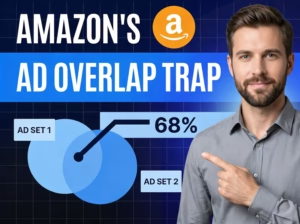
2. Escaping the “Ad Overlap Trap” As you scale, you naturally start running Sponsored Products, Sponsored Brands, and Display ads at the same time. The standard Ad Console counts the sales from all three independently, making you think they are all performing brilliantly.
AMC shows you the Venn diagram of how those ads overlap.
- The “Aha” Moment: You run a Media Mix Overlap report using the AI Agent. You find out that 80% of the people clicking your expensive Display ads had already searched your exact brand name and were going to click your Sponsored Product ad anyway. You are accidentally paying Amazon twice for the exact same customer. By pausing the redundant ad, your Total Advertising Cost of Sale (TACoS) drops overnight without losing a single sale.
3. Building “Goldmine” Custom Audiences AMC is not just a reporting dashboard; it is an audience creation engine. Because you can see every step a shopper takes, you can isolate the exact moments where they almost bought, but didn’t.
- The “Aha” Moment: You use the natural language prompt to tell the AI: “Find shoppers who added my $150 espresso machine to their cart, saw my ads at least three times in the last month, but never purchased.” AMC instantly generates that highly-qualified list. You can then automatically push that exact audience to Amazon DSP or Sponsored Display and hit them with a 10% off coupon. You are no longer marketing to cold traffic; you are closing warm leads.
VII. Conclusion: Moving From Guesswork to Precision
Surviving as a private label seller on Amazon today requires a fundamental mindset shift. You can no longer afford to run your business through the peephole of the standard Ad Console.
Amazon Marketing Cloud (AMC) is your bay window. It takes you from guessing which ads might be working to mathematically proving exactly how your customers are buying. By stepping inside the clean room, you stop accidentally paying Amazon twice for the same shopper, you uncover the true lifetime value of your products, and you build a competitive moat that other sellers in your niche simply cannot cross.
The Fortune 500 myth is dead. The SQL coding barrier is gone. With Amazon’s new AI Ads Agent and “AMC for All” self-service access, the only thing standing between you and your most profitable data is the decision to log in and ask your first question.