





Introduction: From Data Access to Decision Advantage
Amazon sellers today are not suffering from a lack of data. If anything, the opposite is true. Advertising dashboards, campaign reports, and performance metrics provide a constant stream of information. Yet despite this abundance, many sellers still struggle to answer a fundamental question: What is actually driving growth?
Traditional reporting tends to describe outcomes rather than explain them. A spike in conversions may appear tied to a specific campaign, but what influenced the shopper beforehand often remains invisible. As advertising strategies become more layered—spanning Sponsored Products, Sponsored Brands, display placements, and video—the customer journey grows increasingly complex.
Amazon Marketing Cloud (AMC) was built to illuminate this complexity. Rather than presenting isolated metrics, it enables sellers to analyze relationships between exposures, understand sequencing across touchpoints, and evaluate how campaigns work together as a system.
However, the real value of AMC is not access to more data. It is the ability to generate insights that materially improve decision-making. Sellers who treat AMC as a strategic intelligence layer gain clarity. Those who treat it as another reporting tool often gain little.
What Makes AMC Use Cases Different from Standard Reporting
Most Amazon reporting environments answer predefined questions. AMC, by contrast, allows sellers to ask their own.
This distinction is critical. Custom analysis makes it possible to identify behavioral patterns rather than relying solely on aggregated results. Sellers can examine how long customers take to convert, which ad exposures tend to occur first, and whether certain formats consistently assist others.
In this sense, AMC shifts measurement from campaign-level performance toward system-level understanding. It reveals hidden drivers that traditional dashboards cannot surface, helping sellers move from reactive optimization to deliberate strategy.
Understanding the True Customer Journey
One of the most powerful applications of Amazon Marketing Cloud is mapping the path from initial exposure to final purchase.
Shoppers rarely convert after a single interaction. More often, they encounter a brand multiple times across different formats before making a decision. A Sponsored Brands video may introduce the product. A display ad might reinforce awareness days later. A Sponsored Products placement could ultimately capture the conversion.
Without AMC, much of this journey remains invisible.
By analyzing touchpoint sequences and time-to-purchase patterns, sellers can better understand how consideration develops. Some products convert quickly, while others require repeated exposure. Recognizing this distinction allows sellers to design advertising strategies that reflect actual buying behavior rather than assumptions.
The strategic implication is significant: budgets should be informed by contribution across the journey—not just by who receives last-click credit.
Identifying Assist Value Across Ad Formats
Upper-funnel advertising has long been difficult to evaluate. Formats designed to build awareness or consideration often appear inefficient when judged solely by direct conversions.
AMC helps quantify their assist value.
When sellers analyze cross-format interactions, they often discover that campaigns previously viewed as underperforming were quietly supporting downstream conversions. Removing these touchpoints can reduce overall sales even if lower-funnel metrics initially appear stable.
This does not mean every awareness campaign is justified. It means sellers should evaluate advertising through the lens of interaction, not isolation.
Understanding assist behavior enables more confident investment decisions and reduces the risk of cutting initiatives that contribute to long-term growth.
Eliminating Campaign Overlap and Cannibalization
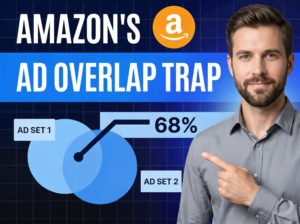
As advertising accounts scale, structural inefficiencies tend to emerge. Multiple campaigns may target the same audiences, compete for identical placements, or generate redundant impressions.
These issues are rarely obvious in standard reports because each campaign appears to perform independently.
AMC allows sellers to detect patterns of overlap, excessive frequency, and internal competition. In many cases, efficiency gains come not from increasing spend but from refining structure.
Reducing redundancy can lower acquisition costs while preserving reach. More importantly, it helps ensure that each campaign plays a distinct role within the broader advertising system.
Efficiency, at scale, is often a function of clarity rather than aggression.
Optimizing Budget Allocation with Behavioral Data
Budget decisions are frequently reactive. Sellers shift spend toward campaigns that appear to convert and away from those that do not.
AMC enables a more strategic approach by revealing how campaigns contribute across the funnel. Some introduce new customers. Others reinforce brand familiarity. Still others capture high-intent demand.
Seen through this lens, advertising budgets begin to resemble investment portfolios. The objective is not to maximize the performance of any single campaign but to balance roles in a way that strengthens the entire system.
Behavioral insight allows sellers to allocate capital with greater precision, supporting sustainable growth rather than short-term spikes.
Measuring Incrementality Instead of Assumptions
Perhaps the most executive-level capability AMC supports is incrementality analysis—the ability to evaluate whether an ad actually generated new demand.
Attribution alone cannot answer this question. A campaign may receive credit for a sale that would have occurred regardless of exposure. Conversely, some initiatives may create genuine lift that remains underappreciated.
Incrementality reframes measurement from “What was attributed?” to “What changed because we advertised?”
This distinction helps sellers avoid overspending on tactics that merely capture existing demand while identifying those that expand it. Over time, incrementality analysis promotes more disciplined investment and protects margins from hidden inefficiencies.
Audience Insights That Inform More Than Advertising
AMC insights extend beyond campaign optimization. Understanding how audiences behave can influence broader commercial decisions.
Patterns uncovered in AMC may suggest adjustments to product positioning, creative direction, or messaging hierarchy. They can highlight which value propositions resonate most strongly or which customer segments require additional education before converting.
These insights can also inform keyword strategy and Product Detail Page (PDP) development, ensuring that shopper expectations align with listing content.
When applied thoughtfully, advertising intelligence becomes business intelligence.
Turning AMC Insight Into Execution with Ailumia
Insight alone does not create advantage. Execution does.
Amazon Marketing Cloud excels at revealing patterns, but organizations must translate those patterns into operational change. This is where structured platforms become essential.
Within Ailumia’s ecosystem, SellerHub analytics help teams contextualize AMC findings alongside campaign performance and catalog data. Rather than existing in isolation, insights can be evaluated within the broader commercial environment.
Keyword Manager connects behavioral analysis to real search demand, allowing sellers to refine targeting strategies with greater confidence. Listing Master ensures that PDP updates reflect observed shopper behavior, reinforcing alignment between advertising and conversion environments. Meanwhile, AI Copywriter supports scalable messaging refinement as audience insights evolve.
Through Ailumia 360 dashboards, complex data becomes actionable workflows, enabling teams to move from interpretation to implementation with consistency.
The principle is straightforward: insight without execution creates no advantage.
Common Mistakes Sellers Make with AMC
Despite its capabilities, AMC does not guarantee clarity. Sellers who approach it without structure often struggle to extract meaningful value.
A common misstep is conducting analysis without a hypothesis. Effective use of AMC begins with a question—one grounded in a strategic objective. Another pitfall is becoming overly focused on technical complexity rather than practical outcomes.
Perhaps most importantly, some organizations fail to operationalize what they learn. Insights that do not influence budgets, structure, or messaging remain academic.
Discipline, not novelty, determines whether AMC becomes transformative.
Who Should Prioritize These Use Cases
Not every seller needs AMC immediately. Early-stage operators typically benefit more from strengthening execution fundamentals before investing heavily in advanced analytics.
However, as budgets expand and advertising structures grow more sophisticated, the cost of operating without system-level visibility increases.
AMC becomes particularly valuable when:
- Multiple ad formats are active
- Customer journeys lengthen
- Investment levels rise
- Strategic planning outweighs tactical optimization
At this stage, understanding interaction effects is no longer optional—it is foundational.
The Emerging Future of AMC Use Cases
Advertising measurement is moving toward greater automation, predictive modeling, and AI-assisted interpretation. Privacy-safe analytics environments like AMC are likely to become standard infrastructure rather than specialized tools.
As these capabilities mature, the competitive gap between sellers who understand their systems and those who rely on surface metrics will widen.
Future use cases will increasingly focus on forecasting behavior rather than simply explaining it, allowing organizations to anticipate performance rather than react to it.
Conclusion: The Sellers Who Win Will Be the Ones Who Understand Their Systems
Data is abundant. Insight is scarce. Execution is the differentiator.
Amazon Marketing Cloud offers sellers an opportunity to see their advertising ecosystem with greater clarity—to understand how touchpoints interact, how budgets influence behavior, and where true growth originates.
Yet technology alone does not create advantage. The sellers who lead their categories will be those who pair deep measurement with disciplined operational systems.
In modern Amazon advertising, success belongs not to those with the most data, but to those who understand what their systems are telling them—and act accordingly.