





Introduction
In today’s fast‑paced e‑commerce environment, launching a successful product is more challenging than ever. With saturation growing, the key advantage lies in discovering what consumers are buying right now, and what they will want next. That’s why these three Amazon insight lists — the Best Sellers, the Hot New Releases, and the Movers & Shakers — are so valuable to product researchers. Each list offers a different vantage point: one shows what already sells strong, one reveals what is new and gaining momentum, and one surfaces what is rapidly rising in interest. Using all three together gives you a fuller, layered view of demand.
In this article, you will learn what each list signals and why it matters, followed by a rigorous unified workflow you can apply to turn those signals into validated product ideas — backed by data, not just intuition.
Why Use These Three Amazon Lists?
Amazon Best Sellers List – Proven Demand
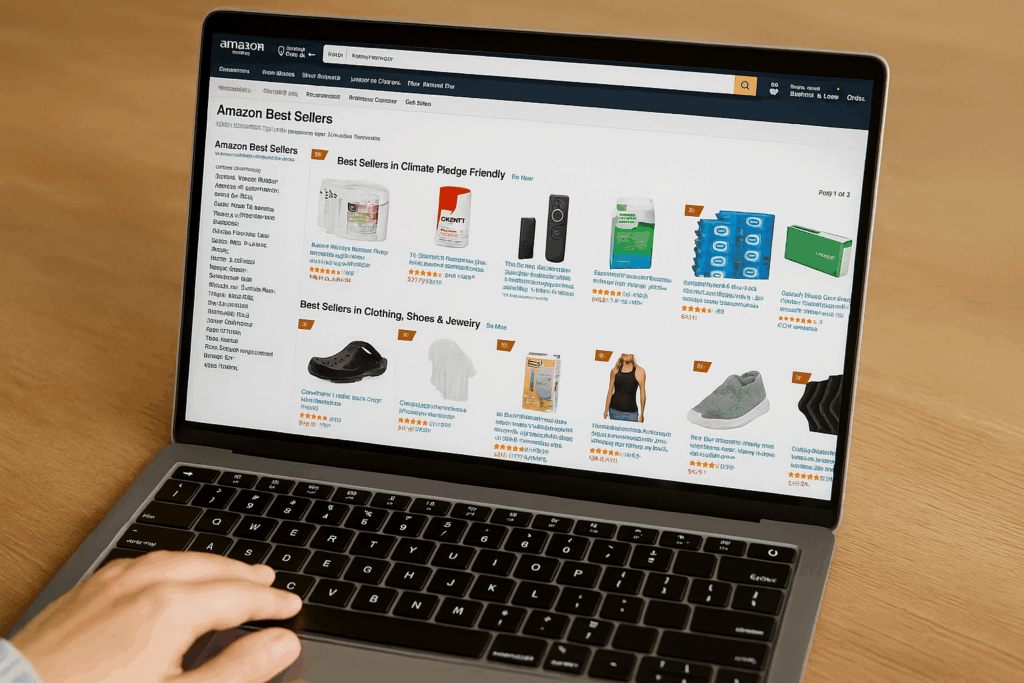
The Best Sellers list on Amazon showcases items that consistently rank high in their category. Products here have established demand and buyer behaviour behind them. According to Amazon’s blog on product ideas, the Best Sellers list is a foundational resource because it offers a snapshot of current market demand, showing which items are performing consistently well across categories. It helps sellers “identify opportunities in high‑demand categories” and inspires innovation through observation. By understanding what customers already value—and where they express dissatisfaction—you can formulate products that meet demand while correcting flaws in current offerings.
Amazon Hot New Releases List – Early‑Stage Opportunities
The Hot New Releases list (or similar recently‑launched items trending) lets you spot early momentum. These are products just entering market or rapidly gaining attention — fewer competitors may have jumped in yet. Amazon encourages sellers to explore “emerging products and trends,” making this list a valuable source for early entry before saturation. This gives you a chance to act earlier, ride the wave, and potentially secure stronger positioning while others lag.
Amazon Movers & Shakers List – Trend Acceleration
The Movers & Shakers list highlights items that have made the largest jump in sales rank over the last 24 hours. While the Best Sellers list is about volume and consistency, Movers & Shakers is about momentum — what is heating up right now. Amazon recommends tracking “fast‑growing items” as a way to understand short‑term shifts in consumer behaviour, spot viral potential, and get in early before the trend becomes mainstream. This makes it especially useful for spotting rising niches and fast‑moving ideas.
By combining these three lists — proven demand (Best Sellers), early movers (Hot New Releases) and live momentum (Movers & Shakers) — you build a more robust product‑ideation process. The next step is how to research and validate those ideas systematically.
Unified Workflow: From List Insight to Validated Product Idea
Once you’ve used any of the lists above to identify a product or niche that looks interesting, you then apply the following unified workflow to research demand, analyse competition, and validate your idea—before you commit to sourcing and launch.
1. Select & Explore the List
Begin by navigating to one of the three lists and selecting a category or sub‑category that aligns with your interests or capabilities. For example, you might go to the Best Sellers list in Home & Kitchen, or the Movers & Shakers list in Baby Products. Focus on products that stand out: best‑ranked items in Best Sellers, newly trending items in Hot New Releases, or items showing sharp rank gains in Movers & Shakers. Ask yourself: what’s driving the performance? What category is this in? What features seem to resonate?
2. Analyse Features & Customer Feedback
Once you’ve selected a product, dive into its listing and especially its customer reviews. The goal is to map what customers love about it and what they complain about. When reviews repeatedly mention issues like “lid leaks”, “hard to clean”, “short cord” or “no colour choice”, you’ve identified real pain‑points. These become the innovation window for your version of the product. Understanding the existing communication (title, bullet points, images) helps you position your improvement.
3. Develop a Product Idea
Based on the gap insight, you craft your variant: perhaps better materials, added features, superior packaging, a bundle, or a unique aesthetic. For example, you might identify a best‑selling silicone container that many users say is difficult to close, so your idea might be “reinforced clip‑lid silicone container with built‑in vent and heat‑resistant handle”. This is your concept—a product idea still to be validated.
4. Demand & Competition Research (using a tool like Ailumia’s Market Radar)
This step turns intuition into data. Using a tool like Ailumia Market Radar (or comparable research platforms) you gather key metrics:
- Estimated market size and recent sales volume for that niche.
- Trend trajectory: Is demand growing, stable, or declining?
- Competitive landscape: How many brands dominate? How saturated is the space?
- Keyword research: What search terms are relevant? Are they increasing in volume?
- Opportunity score: Many tools generate a composite metric indicating demand vs competition. For instance, Ailumia describes its Market Radar functionality as identifying “high‑demand, low‑competition product niches”.
If you find that demand is strong and competition is moderate or low, you have a much stronger basis for proceeding. If demand is weak or competition fierce, you may need to refine your idea or pivot.
5. Decide Viability & Positioning
With data in hand, evaluate whether your idea is viable. Consider sourcing cost, estimated selling price, shipping/logistics cost, Amazon fees, profit margin, lead times. Also decide how you’ll differentiate: What is your unique selling proposition (USP)? How will your listing stand out (title, images, reviews, brand)? What marketing channels will you leverage (PPC, social media, influencer)? This step ensures you’re not just entering a niche, but entering smartly.
6. Launch & Monitor
Once you decide to go ahead, launch your product, but don’t stop there. Monitor key metrics: conversion rate, review growth, sales rank progression, keyword ranking. If you entered via Movers & Shakers trend, timing is especially important—act quickly and be ready to scale if momentum holds or pivot if it fades. Be alert to competitor entry, pricing changes, and trend shifts. Having flexibility and monitoring systems in place ensures you adapt as the market evolves.
Case Examples
To illustrate how the combined approach works, here are three hypothetical scenarios:
- From the Best Sellers list: You notice a stainless‑steel travel mug consistently ranking in the top five of Kitchen & Dining. Reviewers repeatedly say “lid leaks occasionally” and “colours fade”. You conceptualise “premium travel mug with leak‑proof double‑clip lid and colour‑fast powder coating”. You plug keywords into Market Radar: niche shows ~5,000 monthly searches, trend stable, competition moderate. You validate and launch.
- From the Hot New Releases list: You spot a newly launched magnetic cable organiser climbing in Electronics Accessories. It features modular segments and sleek design. You decide to develop “magnetic cable organiser for creative professionals with leather‑wrap option and desk mounting”. Research shows demand is rising, fewer competitors. You act quickly to launch with early‑bird pricing.
- From the Movers & Shakers list: In the Toys & Games category you observe a mini‑drone kit spike in rank, apparently driven by a viral social‑media video. Reviews note “kids love it, but battery life is short”. You build a “STEM‑learning mini‑drone kit with extended battery, learning app & accessory bundle”. Your data says keyword volume is rising 30 % week‑over‑week, competition still small. You launch fast, monitor closely.
In each of these examples you applied the same unified workflow: list insight → gap/feature analysis → idea → data‑validation → viability assessment → launch & monitoring.
Practical Tips & Best Practices
Monitoring each list with the appropriate frequency is key: for Movers & Shakers, check daily or hourly because trends move fast. Hot New Releases can be scanned weekly. Best Sellers may require weekly or bi‑weekly category audits. Use tools to set alerts or trackers for rank changes and keyword volume.
Don’t focus on just one product: look for macro‑category signals—if multiple products within a sub‑category are trending, that signals more than a single isolated hit. But also beware of hype traps: a product may spike because of a one‑time event or viral piece of content—and then drop off. Use your demand research (step 4) to validate sustainability.
Combine Amazon list insights with other data: Google Trends, social‑media mentions, niche forums. A trend showing up on Amazon plus buzz outside often signals bigger opportunity. And remember logistics: being first matters, but only if your supply chain can support it. You’ll need sourcing, inventory management, shipping and contingencies in place. Differentiation is critical: demand is just half the equation. How you stand out matters—better feature, better branding, better customer service.
Conclusion & Call to Action
By leveraging the three Amazon insight layers—Best Sellers for proven demand, Hot New Releases for early momentum, and Movers & Shakers for trend acceleration—you gain a layered and powerful product‑research strategy. But insight alone isn’t enough. The unified workflow we’ve laid out ensures you move from insight to action, backed by data and validated research.
Here’s your action plan:
- Choose 3 categories that align with your interest or expertise.
- Spend the next week monitoring all three lists in each category, and note any items that stand out.
- For at least 5 shortlisted ideas, conduct full demand & competition research (via Market Radar or equivalent).
- Choose your strongest idea, validate viability (margins, sourcing, differentiation) and prepare your launch.
- Launch smartly, monitor closely, adapt quickly.
Start today—because the window for capitalising on emerging opportunity can be short, and timing gives you the edge. Good luck with your next winning product!
FAQs
What’s the difference between Amazon Best Sellers and Movers & Shakers?
The primary difference is time frame and focus. Best Sellers reflect top‑selling products over a longer period and show products with sustained demand. Meanwhile, the Movers & Shakers list shows products that have made significant jumps in sales rank over the past 24 hours—indicating fast‑emerging trends.
How often are these lists updated?
Both lists update frequently. For example, the Best Sellers list’s BSR (Best Sellers Rank) is updated hourly in many cases. The Movers & Shakers list is also updated hourly or at least daily and reflects recent shifts in rank.
Can I rely solely on one list for product research?
You can, but you’d miss the deeper picture. Relying only on Best Sellers gives insight into established demand, but you’ll miss early movers and rising trends. Combining all three gives you proven / emerging / accelerating views—which lowers risk and enhances your chances.
How do I know if a product from Movers & Shakers has lasting demand?
To check sustainability, look beyond the spike: see if reviews are growing, keyword search volume is rising, competitors are entering slowly (not flooding in). Use your demand research tool (step 4) to assess trend stability, not just a one‑day bump.
Should I focus on one category or multiple?
It’s wise to begin with one or two categories you deeply understand—but keep an eye on adjacent categories too, because trends often spill over. Over time you may expand to more, but having niche expertise early is a plus.